
I recently produced a series of shows exploring what several popes—and the most recent ecumenical council—have taught about salvation for non-Catholics. The response from online Catholics has been both fascinating and, at times, deeply troubling. The widespread ignorance of magisterial teaching, and the way many Catholics react when confronted with the very doctrines they claim to uphold, is revealing. It shows just how many Catholics reject official Church teaching—and how Protestant their views often are beneath a Catholic façade.
This becomes evident when one simply cites Pope St. John Paul II’s general audience from September 9, 1998:
“Normally, ‘it will be in the sincere practice of what is good in their own religious traditions and by following the dictates of their own conscience that the members of other religions respond positively to God’s invitation and receive salvation in Jesus Christ, even while they do not recognize or acknowledge him as their Saviour’ (cf. Ad gentes, nn. 3, 9, 11)” (Pontifical Council for Interreligious Dialogue – Congregation for the Evangelization of Peoples, Instruction Dialogue and Proclamation, 19 May 1991, n. 29; L’Osservatore Romano English edition, 1 July 1991, p. III).
When confronted with magisterial statements like these—which are numerous—a range of reactions typically follow. One common response is to reinterpret the quote in a way that conveniently ignores its plain meaning. Another is to attack the messenger who cites the quote, as if discrediting the person somehow nullifies the content. But in reality, the quote stands on its own—the messenger could disappear entirely, and the text would remain, posing the same challenges for Catholics who hold an overly simplistic view of Catholic soteriology. Rare, however, is the person who engages the text honestly and accurately. That is what I’ve done in the past, and what I intend to do again here.
At the outset, it’s important to recognize that the pope is not merely expressing a personal opinion; he is teaching in his official capacity as the Roman Pontiff during a general audience. Furthermore, he isn’t presenting this as his own isolated view—he is clearly building on the Second Vatican Council’s document Ad Gentes and also drawing from the Instruction Dialogue and Proclamation issued by the Pontifical Council for Interreligious Dialogue. It’s also worth noting that these documents do not exhaust the teaching expressed in his statement. Rather, they represent just the tip of the iceberg, with numerous other passages from Vatican II and subsequent papal documents affirming the same point.
Now consider what Pope John Paul II is actually saying. He asserts that a non-Christian can be saved by sincerely practicing the good found within their own religious tradition. To be sure, he qualifies this by affirming that it is Jesus Christ who ultimately saves the person through those good elements present in their religion. In the surrounding context, he also emphasizes that it is the Holy Spirit at work within non-Christian religions, producing these true and salvific elements. He does not deny that salvation comes through Christ, nor that it is found in the Church alone. But he nonetheless maintains that a person may be saved by practicing their non-Christian religion—because that religion contains truths that originate from God.
Elsewhere, he acknowledges that non-Christian religions contain errors, and these errors can pose obstacles to salvation. Yet, he suggests that these obstacles are sometimes overcome when a person embraces the good within their religion. In fact, he goes so far as to say this is “normally” the case.
Some may attempt to reinterpret this as simply saying that the good elements in non-Christian religions serve as a preparation for the eventual acceptance of the Gospel. But this interpretation is directly contradicted by what he says next: that such individuals can be saved “even while they do not recognize or acknowledge him [Jesus] as Saviour.” In other words, it is possible for someone to go their entire life without knowing Christ or formally becoming a Christian, yet still be mystically united to Jesus and his Church through their sincere practice of the good found in their non-Christian religion.
This clearly indicates that a Muslim may be saved by Jesus—even while denying that He is the Son of God—through the sincere practice of the Islamic faith. The same principle would apply to a Hindu practicing Hinduism, a Buddhist practicing Buddhism, and adherents of other non-Christian religions.
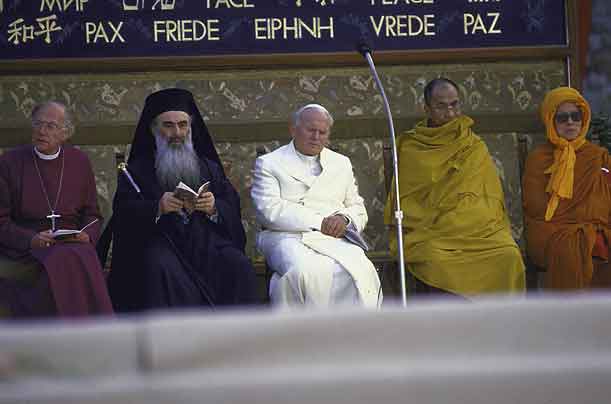
This would certainly help explain why, at the Assisi prayer meeting in 1986, Pope John Paul II invited representatives of all religions to join him in praying to whatever higher power they believed in for world peace. The reasoning appears consistent with his broader theological perspective: he believed that when people of other religions sincerely call upon their god—or gods, or higher power—they do so in good faith. As such, the true God, who knows their hearts, would hear their prayers and respond accordingly.
Some may try to dismiss this as merely the personal magisterium of one pope. But the deeper issue is that Pope John Paul II was simply reiterating what the Second Vatican Council had already taught. And he was not alone—Cardinal Ratzinger (later Pope Benedict XVI) and Pope Francis have also affirmed the same teaching. I have already examined numerous passages from Scripture and also other magisterial documents, including Unam Sanctam, Cantate Domino, Lumen Gentium, Nostra Aetate, Dominus Iesus, and the Notification on the Book Toward a Christian Theology of Religious Pluralism by Fr. Jacques Dupuis, S.J. Each of these, in their own way, either confirms what John Paul II taught above or can at least be harmonized with it.
At this point, I can already hear the objections—particularly from many Catholics—quoting John 14:6 and a host of other biblical passages, along with various earlier magisterial statements. These are often cited as if to suggest that the popes and the Second Vatican Council are contradicting Scripture and the Church’s prior teachings. But isn’t it the role of the living Magisterium to authentically interpret both Scripture and past magisterial acts? That is, after all, what the Magisterium itself teaches.
And yet, here we see a curious phenomenon: Catholics appealing to their own private interpretation in order to discredit the interpretation given by multiple popes. Is this really how Catholicism operates—private judgment over the Magisterium? Ironically, these same Catholics would immediately object if a Protestant did the exact same thing. Martin Luther and others justified their break with Rome by claiming that the Magisterium had contradicted the plain meaning of Scripture. The parallel is striking, isn’t it?
Others might respond by saying they’re not objecting to the interpretation of the popes themselves, but rather to my interpretation and depiction of what the popes have said. And of course, people are always free to challenge anyone’s reading of a magisterial text. But isn’t that, in itself, revealing? Here we have one Catholic interpreting the Magisterium one way, and another interpreting it differently. Yet isn’t the very purpose of the Magisterium to eliminate precisely this kind of private interpretation and internal conflict?
Some might reply, “Well, we can always turn to the Magisterium for further clarification.” But that’s where the irony deepens: the Magisterium has clarified this issue—repeatedly—and it has done so in the very terms I’ve outlined above. How many more times must it say something plainly before people stop insisting it hasn’t been said? And if someone were to go back to Rome today asking for clarification—which is increasingly rare, given how infrequently Rome responds to dubia—they would almost certainly receive more of the same: the claim that non-Christians can be saved by Jesus without knowing it is Jesus who saves them, because they are sincerely embracing and practicing the good found within their non-Christian religion.
At this juncture, some will inevitably say, “Well, the popes are just wrong, and they didn’t teach this ex cathedra or infallibly, so we can simply reject it.” But that is not what the Magisterium teaches. The Church calls for religious submission of intellect and will even to non-definitive teachings. I’ll also add that Pope John Paul II explicitly taught that the Holy Spirit protects the teachings of the popes – even those that are NOT ex cathedra.
“Alongside this infallibility of ex cathedra definitions , there exists the charism of assistance of the Holy Spirit, granted to Peter and his successors so that they may not err in matters of faith and morals and instead provide good enlightenment to the Christian people. This charism is not limited to exceptional cases, but embraces, in varying degrees, the entire exercise of the magisterium.” (General Audience, Wednesday, March 24, 1993)
Moreover, this line of reasoning only makes the situation worse. If the claim is that the Church can teach what critics would likely consider heretical, but that it doesn’t matter because it wasn’t ex cathedra and thus “the gates of hell have not prevailed,” then the Magisterium’s claims about its reliability become a joke. The Church has emphatically declared that it will remain free from all error, undefiled and unblemished until the end. It promises freedom from any poisonous food of error.
Yet if these promises apply only to a few rare ex cathedra teachings, then the claim that the Magisterium is a reliable and sure guide becomes laughable. It would be like me saying, “I will always be entirely faithful to my wife,” but then qualifying that to mean only one hour on one day per year—remaining faithful only during that brief window. Even if I were unfaithful every other hour and day, I would still claim to be “entirely faithful” because I didn’t cheat for that one hour. This would not only reveal dishonesty and bad faith, but also destroy any trust in my future promises.
This analogy illustrates how we should view Catholics who excuse what they label “papal heresy” in the ordinary papal Magisterium—or even in ecumenical councils—simply because these teachings are not ex cathedra. To excuse such errors on that basis is disingenuous and undermines the entire claim to the Magisterium’s reliability.
That said, the same difficulty arises when comparing John 14:6—“I am the way, the truth, and the life. No one comes to the Father except through Me”—and the Catholic dogma that “outside the Church there is no salvation” with later claims that Jesus can save non-Christians through the positive elements in their religions, even if they never know Jesus as their Savior or formally become Christians.
This kind of reinterpreting or reconditioning earlier clear statements poses the same challenge some have with claims like, “And on this rock I will build my Church, and the gates of hell shall not prevail against it,” or Vatican I’s teaching that the See of Peter “always remains unblemished by any error,” being reduced to mean only that in rare ex cathedra cases the pope is free from error.
The simple fact is that the popes have consistently taught about the salvation of non-Christians over many years and in numerous official documents. If those teachings are erroneous—or worse, heretical—then insisting the See of Peter remains unblemished merely because a handful of ex cathedra teachings are free from error reduces the whole claim of infallibility to a farce.
Furthermore, if Catholics must rely on their own private judgment not only to interpret the Magisterium but also to override previous magisterial statements in favor of their own interpretation—against the authoritative teaching of the living Magisterium—then we have effectively returned to the Protestant method: using private judgment to overrule the Church’s authority. This is exactly what Martin Luther did when he appealed to Scripture and past magisterial statements to reject the teachings of the Magisterium in his own time.
At this juncture, Catholics who struggle with the popes’ teaching on the salvation of non-Christians face a few options. They must either set aside their private judgment of Scripture and past magisterial teachings and submit to the living Magisterium’s authoritative interpretation—precisely what the Magisterium itself instructs, with only rare exceptions outlined in Donum Veritatis—or they must admit they are unwilling to accept the Catholic paradigm of deferring to the Church’s judgment on faith and morals. In that case, they would essentially be embracing the Protestant model of private judgment. Alternatively, they could conclude that the Catholic Church has lost its claim to authenticity and seek other spiritual paths.
Of course, the Magisterium advocates for the first option. Yet many Catholics find themselves unable to follow that path. At that point, they should honestly admit that Catholicism is not the faith they are prepared to embrace—rather than disingenuously remaining “Catholic” in name only, while fostering dissent and tension within a community whose teaching authority they reject.
They should especially take this step if they’re simultaneously chastising Protestants online for not embracing Catholicism. It’s deeply inconsistent to urge Protestants to enter the Catholic Church—outside of which, they claim, there is no salvation—while also insisting that the Church teaches heresy and cannot be trusted. Imagine that sales pitch: “Hey Mr. Protestant, come join the one true Church outside of which you cannot be saved—but be warned, this Church may lead you astray with false teachings, so don’t actually trust what it says.”
That is not only an internally incoherent position, but a call that few, if any, will find compelling. And yet, I suspect many Catholics will continue to foster this kind of dissent—urging others to enter the Church while simultaneously undermining its authority and teachings. Such a posture does little more than erode credibility and create confusion, both for those within the Church and for those looking in from the outside.
But hey, what do I know? I’m just a “popesplainer.” So here’s my suggestion: go ask my critics. Ask them how they make sense of all this—how they reconcile these teachings with the Magisterium. Surely, they know theology well enough to offer a coherent explanation, right? Surely, they have a clear and consistent framework for understanding the very Magisterium they claim to defend. Right?