
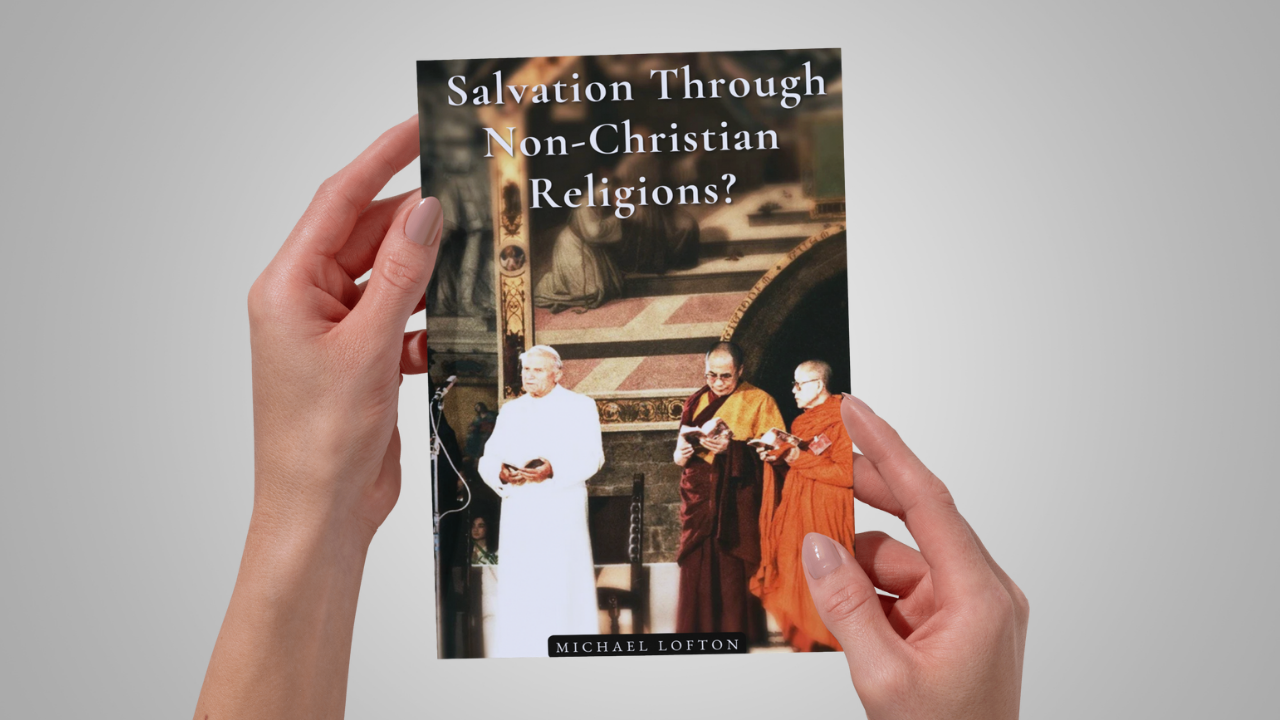
Did the Pope Teach That Salvation Through Non-Christian Religions is Possible?
Michael Lofton
Initial Qualifications
In recent decades, the Catholic Church has offered increasingly nuanced teachings on the possibility of salvation for non-Christians. One of the more significant and frequently discussed contributions to this topic is a general audience delivered by Pope St. John Paul II, in which he appears to affirm that Jesus can save non-Christians through the sincere practice of the good found within their own religious traditions. Though situated within his ordinary papal magisterium, this teaching has sparked both interest and controversy.
This article examines the content and context of that teaching, including the qualifications placed upon it by both John Paul II and other magisterial sources. It also considers how this view aligns with earlier and subsequent magisterial teachings, whether it is contradicted by Dominus Iesus, and how it relates to common theological concerns—such as the uniqueness of salvation in Christ, the meaning of Extra Ecclesiam Nulla Salus, and the role of private interpretation in evaluating magisterial authority.
My goal is to provide a clear and accurate account of the Church’s post-conciliar teaching on this issue, and to encourage thoughtful reflection and discussion among Catholics seeking to better understand the Church’s position.
Because this is a sensitive and often misunderstood topic, it is important to approach it with honesty and clarity. Many come to the question of non-Christian salvation with strong assumptions or limited exposure to the full range of the Church’s teaching. Understandably, reactions can be emotionally charged or based on partial information. I do not raise this point to criticize, but to encourage readers to set aside preconceptions and engage the material calmly and thoughtfully, with a willingness to consider the Church’s teaching in its proper context.
Before proceeding, it is worth clarifying what this article is not. First, it is not an attempt to assess whether the post-conciliar teaching is in continuity or discontinuity with pre-conciliar doctrine. That is a worthwhile discussion, but it lies outside the scope of this treatment. Second, this is not an expression of my personal opinion. I have deliberately chosen not to share my own view, as doing so often distracts from the real focus—namely, what the Magisterium itself teaches. Whether I agree or disagree with the post-conciliar developments is beside the point here and can be addressed elsewhere. The aim is simply to let the Church speak for itself.
This is also not an exhaustive study. Nonetheless, I believe what follows offers a faithful and representative summary of the Church’s official teaching on the subject. Readers who believe the material is misrepresented are welcome to engage critically with the sources cited.
Finally, I recognize that some Catholics may find this content difficult or even frustrating. If so, it’s important to understand that the frustration lies not with me personally, but with the magisterial teachings themselves. To wrestle with these teachings is, for Catholics, to wrestle with the authority they profess to follow.
Having now laid out the scope and intent of this article, we may turn to the teaching itself.
The Obligation of Catholics to Assent to Non-Definitive Magisterial Teachings
Since we are going to begin by examining a general audience by Pope St. John Paul II, it is important to recall that general audiences, while among the lower levels of the papal magisterium, nonetheless belong to the ordinary magisterium of the pope. As such, according to Lumen Gentium 25, the Profession of Faith, Donum Veritatis, and other magisterial documents, they require a religious submission of intellect and will from the faithful.
While Donum Veritatis does outline extremely limited circumstances in which a well-formed theologian may withhold assent—always with humility and in fidelity to the Church—such cases are exceptional and do not apply to the vast majority of Catholics in the vast majority of situations. In short, although general audiences carry less weight than dogmatic or solemn teachings, they are still authoritative and require appropriate assent from Catholics in most cases.
The Profession of Faith, which all Catholics are required to affirm, explicitly states:
“Moreover, I adhere with religious submission of will and intellect to the teachings which either the Roman Pontiff or the College of Bishops enunciate when they exercise their authentic Magisterium, even if they do not intend to proclaim these teachings by a definitive act.”
Contrary to what many Catholics assume, the Church requires the faithful to adhere not only to infallible teachings but also to certain non-definitive teachings. Some believe that only infallible doctrines demand assent and that everything else is open to personal opinion. However, any well-formed Catholic knows that there is an entire category of non-definitive magisterial teachings that still require religious submission of will and intellect.
Donum Veritatis does outline rare and specific circumstances in which a well-formed theologian may—with humility and fidelity to the Church—temporarily withhold assent from certain non-definitive teachings. However, such situations are exceptional and do not apply to the vast majority of Catholics. In short, while General Audiences do not carry the same weight as solemn or dogmatic pronouncements, they remain authoritative and generally require assent from the faithful.
The September 9, 1998 General Audience of Pope St. John Paul II
On September 9, 1998, Pope St. John Paul II delivered a message during a general audience that may understandably raise some eyebrows. He stated:
“The Holy Spirit is not only present in other religions through authentic expressions of prayer. The Spirit’s presence and activity, as I wrote in the Encyclical Letter Redemptoris Missio, affect not only individuals but also society and history, peoples, cultures, and religions (n. 28).
Normally, it will be in the sincere practice of what is good in their own religious traditions and by following the dictates of their own conscience that the members of other religions respond positively to God’s invitation and receive salvation in Jesus Christ, even while they do not recognize or acknowledge him as their Saviour (cf. Ad Gentes, nn. 3, 9, 11)” (Pontifical Council for Interreligious Dialogue – Congregation for the Evangelization of Peoples, Dialogue and Proclamation, May 19, 1991, n. 29; L’Osservatore Romano, English edition, July 1, 1991, p. III).
There’s a lot to unpack here, but I’ve chosen to begin with this particular section of the general audience because I believe it gets to the heart of the issue. Despite the various qualifications found elsewhere in the same address—and in many other Church documents, some of which we’ll examine—it’s this passage that most clearly captures the central issue that we will explore in this article.
Note that Pope St. John Paul II explicitly affirms the presence of the Holy Spirit in elements of other religions, specifically referencing non-Christian prayers. To support this claim, he cites his earlier encyclical Redemptoris Missio, where he wrote that “the Spirit’s presence and activity affect not only individuals but also society and history, peoples, cultures, and religions.”
Interpreting the 1998 General Audience in Light of Dominus Iesus
However, this affirmation appears to stand in some tension with his endorsement of Dominus Iesus, a magisterial document which both acknowledges and limits the Spirit’s role in non-Christian religions. In paragraph 21, Dominus Iesus states:
“Certainly, the various religious traditions contain and offer religious elements which come from God, and which are part of what ‘the Spirit brings about in human hearts and in the history of peoples, in cultures, and religions.’ Indeed, some prayers and rituals of the other religions may assume a role of preparation for the Gospel, in that they are occasions or pedagogical helps in which the human heart is prompted to be open to the action of God. One cannot attribute to these, however, a divine origin or an ex opere operato salvific efficacy, which is proper to the Christian sacraments. Furthermore, it cannot be overlooked that other rituals, insofar as they depend on superstitions or other errors (cf. 1 Cor 10:20–21), constitute an obstacle to salvation.”
Both Cardinal Joseph Ratzinger (later Pope Benedict XVI) and Pope St. John Paul II affirmed that the Holy Spirit is, in some sense, at work within non-Christian religions. At the same time, they denied in some sense that the religious elements within these traditions have a divine origin or sacramental efficacy. This creates a certain tension: on the one hand, the Spirit is said to be present and active in various cultures and religions; on the other, that presence is not seen as confirming the divine origin of the religions themselves. This may be because non-Christian religions are viewed as a mix of truth and error—or perhaps to distinguish the Spirit’s activity in them from the way He inspires Sacred Scripture and divine revelation. While both thinkers reject the idea that, in some sense, non-Christian religious elements possess divine origin or sacramental power, it must be stressed that they nonetheless affirm that the Holy Spirit “brings about” genuine expressions of prayer within these traditions, and that “the Spirit’s presence and activity” can indeed be found in them.
In a General Audience, Pope St. John Paul II makes a striking claim: that non-Christians are “normally” saved by Jesus “through the sincere practice of what is good in their own religious traditions.” While he qualifies this by noting that such individuals must be sincerely following their conscience—and while he does not attribute any ex opere operato efficacy to non-Christian rites—it remains significant that he sees salvation occurring through these religious practices.
Elsewhere, such as in Lumen Gentium, the role of invincible ignorance is emphasized, and that framework is clearly in the background here. But what stands out is that the Pope does not treat this kind of salvation as rare or merely preparatory. On the contrary, he explicitly affirms that Jesus can save a person through their engagement in a non-Christian religion. And not in a merely remote or exceptional case—he says this is normally how it happens.
This has major implications. It means, for example, that a Muslim who sincerely worships God through Salah can be saved by Jesus. The same applies to a Hindu practicing their religious tradition in good faith, or a Jew, or a Buddhist, or even an animist. John Paul II is not simply saying that there may be good elements in these religions that dispose someone toward eventual conversion. He does affirm that these good elements can prepare a person to receive the Gospel—but he does not limit himself to that. He clearly states that salvation can occur through the practice of these traditions themselves, insofar as the person sincerely seeks and follows the good.
Even more provocatively, he states that this salvation can happen “even while they do not recognize or acknowledge him [Jesus] as their Savior.” In other words, salvation can occur without an explicit profession of faith in Christ or the Trinity. Those who insist that salvation requires explicit belief in Christian doctrines find themselves at odds with the Pope’s position, which affirms a more implicit faith—one that operates through conscience, sincerity, and the search for truth within one’s own religious context.
In his General Audience, Pope St. John Paul II builds upon the teaching of Gaudium et Spes from the Second Vatican Council. He cites the Council’s affirmation that: “Since Christ died for all, and since all men are in fact called to one and the same destiny, which is divine, we must hold that the Holy Spirit offers to all the possibility of coming into contact, in a way known to God, with the paschal mystery” (Gaudium et Spes, 22). Here, the Pope affirms that God wills the salvation of all people and, consequently, that even those who have never heard the Gospel—or are not yet convinced of its truth—must have some potential path by which the saving grace of Christ can reach them.
According to John Paul II, this mysterious path—this “way known to God”—can be found in the sincere practice of what is good in their own religious traditions. In other words, he interprets the Council’s language to mean that Jesus can save a person through their honest and conscientious adherence to the true and good within their religion, even if they remain unaware that it is Jesus who saves them.
Two years later, the Congregation for the Doctrine of the Faith, under then-Cardinal Ratzinger, released Dominus Iesus, which touches on this question without contradicting the Pope’s earlier teaching. It states:
“With respect to the way in which the salvific grace of God—which is always given by means of Christ in the Spirit and has a mysterious relationship to the Church—comes to individual non-Christians, the Second Vatican Council limited itself to the statement that God bestows it ‘in ways known to himself.’ Theologians are seeking to understand this question more fully. Their work is to be encouraged… However, it would be contrary to the faith to consider the Church as one way of salvation alongside those constituted by the other religions, seen as complementary to the Church or substantially equivalent to her…”
This statement is not in tension with John Paul II’s earlier remarks. The Pope is not suggesting that non-Christian religions, taken as wholes or considered in themselves, are salvific. Nor is he claiming that these religions are equal, parallel, or complementary paths to salvation, as though they were on par with the Church. Rather, he insists that Jesus remains the sole source of salvation, and that He can operate through the good elements found within these religions—not because the religions as such save, but because a sincere response to the good and true is, ultimately, a sincere response to the God who is Truth and Goodness itself.
Thus, John Paul II’s position does not relativize the uniqueness of Christ or the Church’s role in salvation. It affirms that there must be a means by which salvation is possible outside the ordinary channels of the sacraments and formal profession of faith—particularly for those who, through no fault of their own, do not know Christ or the Church. His proposed solution is that Jesus may save such individuals through their sincere and conscientious practice of what is good in their own religious traditions—always by grace, always through Christ, and always under the mysterious guidance of the Holy Spirit.
Dominus Iesus adds further nuance to this discussion by stating: “If it is true that the followers of other religions can receive divine grace, it is also certain that, objectively speaking, they are in a gravely deficient situation in comparison with those who, in the Church, have the fullness of the means of salvation.” While this acknowledges the possibility of grace for non-Christians, it emphasizes that, in relation to the Church, their situation is significantly lacking in terms of access to the fullness of truth and sacramental life.
What Dominus Iesus does not fully address, however, is how this “gravely deficient situation” is to be understood in light of Pope John Paul II’s earlier affirmation that non-Christians are “normally” saved in the sincere practice of what is good in their own religious traditions. Whether or not these two perspectives can be completely harmonized, what remains clear is that Dominus Iesus does not deny the possibility that salvation can occur in the very context it describes as deficient. In fact, it affirms that divine grace can indeed be operative in the lives of non-Christians.
Echoing some of the cautions found in Lumen Gentium, Dominus Iesus also qualifies its position by warning: “It cannot be overlooked that other rituals, insofar as they depend on superstitions or other errors (cf. 1 Cor 10:20-21), constitute an obstacle to salvation.” And yet, despite acknowledging the presence of such obstacles, Pope John Paul II remains confident that a non-Christian can still be saved through the sincere practice of what is good in their religion.
In other words, even after accounting for all the qualifications, cautions, and distinctions presented by Church documents, the essential point remains: John Paul II holds that Jesus can—and normally does—save non-Christians through their sincere engagement with the good found in their own religious traditions. This is not to say that these religions, considered in themselves, are salvific, nor that they stand alongside the Church as equal paths to God. Rather, it affirms that God, in His mercy, works through the elements of truth and goodness present in them to lead souls to salvation through Christ, even when those individuals do not explicitly know or acknowledge Him.
One might ask whether Dominus Iesus, issued in 2000, represents a silent correction or reversal of Pope John Paul II’s 1998 General Audience, in which he stated that non-Christians are “normally” saved in the sincere practice of what is good in their own religious traditions. It is true that Dominus Iesus emphasizes certain limitations, such as the “gravely deficient situation” of non-Christians relative to those within the Church, and cautions against attributing salvific efficacy to non-Christian rituals that are rooted in superstition or error.
However, a closer reading reveals that Dominus Iesus does not contradict John Paul II’s earlier teaching. In fact, the two documents can be harmonized on every point of apparent tension. Dominus Iesus reaffirms that salvation comes through Christ, in the Spirit, and in some mysterious relationship to the Church. Yet it stops short of denying that Christ can operate through the elements of truth and goodness found in other religions. What it rejects is the idea that these religions constitute independent or equal paths of salvation alongside the Church.
This is fully compatible with John Paul II’s affirmation that Jesus can save a person through their sincere response to what is good in their own religious tradition—not because the religion itself saves, but because the grace of Christ is at work in what is true and good. Moreover, the Pope is not merely saying that these good elements serve only to prepare someone to eventually embrace the Christian faith (though he acknowledges that possibility). Rather, he goes further: he explicitly states that a person may be saved by Jesus through the sincere practice of what is good in their own religion, even without knowing that it is Jesus who saves them. This clearly implies that explicit faith in Christ is not strictly required for salvation in such cases.
Evaluating the CDF’s 2001 Notification on Jacques Dupuis
Having said this, one year after the release of Dominus Iesus, Pope John Paul II and Cardinal Ratzinger explicitly reconfirmed the substance of the 1998 teaching in the Notification on Jacques Dupuis’ book, Toward a Christian Theology of Religious Pluralism (January 2001). This Notification, issued by the Congregation for the Doctrine of the Faith and expressly approved by John Paul II in an audience on January 19, 2001, participates in the Pope’s ordinary magisterium, as clarified by Donum Veritatis §18:
“The Roman Pontiff fulfills his universal mission with the help of the various bodies of the Roman Curia and in particular with that of the Congregation for the Doctrine of the Faith in matters of doctrine and morals. Consequently, the documents issued by this Congregation expressly approved by the Pope participate in the ordinary magisterium of the successor of Peter.”
In other words, not only does the Notification carry magisterial weight, but it also clarifies that the CDF, under Ratzinger’s leadership and with the explicit approval of the Pope, continued to affirm that Christ’s grace may be operative in other religions—not as parallel salvific systems, but as instruments through which God may work in ways known to Himself.
Let’s now examine the key passages of this Notification and see how they reinforce rather than reverse John Paul II’s earlier position.
The Notification states:
“In accordance with Catholic doctrine, it must be held that ‘whatever the Spirit brings about in human hearts and in the history of peoples, in cultures and religions, serves as a preparation for the Gospel’ (cf. Lumen Gentium, 16). It is therefore legitimate to maintain that the Holy Spirit accomplishes salvation in non-Christians also through those elements of truth and goodness present in the various religions; however, to hold that these religions, considered as such, are ways of salvation, has no foundation in Catholic theology, also because they contain omissions, insufficiencies and errors regarding fundamental truths about God, man and the world.”
Note first that the Notification reaffirms Lumen Gentium’s teaching that the Holy Spirit is somehow active in non-Christian religions, particularly through elements that prepare individuals for the Gospel. However, as we’ve seen, the Church has not restricted itself to a merely preparatory understanding of these elements. In fact, Pope John Paul II explicitly affirmed in his 1998 General Audience that Jesus can save a person through the sincere practice of what is good in their own religious tradition—even when they do not recognize or acknowledge Him as their Savior. This is not a mere theological opinion; it reflects a development within magisterial teaching that recognizes how grace can operate in ways “known to God.”
The Notification, issued in 2001 and expressly approved by John Paul II, directly echoes this teaching:
“It is therefore legitimate to maintain that the Holy Spirit accomplishes salvation in non-Christians also through those elements of truth and goodness present in the various religions.”
This is precisely what the Pope taught in 1998:
“Normally, it will be in the sincere practice of what is good in their own religious traditions and by following the dictates of their own conscience that the members of other religions respond positively to God’s invitation and receive salvation in Jesus Christ, even while they do not recognize or acknowledge him as their Saviour.”
In short, one cannot claim that Dominus Iesus (2000) silently overturned or corrected the teaching found in the 1998 General Audience. Not only does Dominus Iesus contain no direct contradiction to that earlier teaching, but the position articulated in 1998 is reaffirmed one year after Dominus Iesus, by both Cardinal Ratzinger and Pope John Paul II in a formal magisterial document. This point must be emphasized because some attempt to dismiss the 1998 General Audience by claiming it was superseded by Dominus Iesus. But such claims overlook the 2001 Notification, which explicitly confirms the very teaching they try to reject.
Ironically, then, some try to pit “John Paul II of 1998” against “Ratzinger and John Paul II of 2000,” while conveniently ignoring “Ratzinger and John Paul II of 2001.” It’s a selective and inconsistent approach—arguably even a comical one—that fails to grapple honestly with the continuity of the magisterial teaching. The uncomfortable truth for some is that the Church affirms both the uniqueness of Christ and the possibility that Jesus, in His mercy, saves people through the good elements present in their non-Christian religious traditions.
It is in this qualified and carefully nuanced sense that one can say Pope John Paul II affirms Jesus can save someone through the practice of Buddhism, Judaism, Islam, Hinduism, and other non-Christian religions. For some, this may be an uncomfortable admission—perhaps even one they would describe as male sonans (harsh-sounding or dissonant to Catholic ears). But such a reaction carries little weight if it’s not accompanied by consistency. After all, if the charge of male sonans is to be applied here, then one would also have to apply it to many of the words of Jesus Himself—such as His statement in John 17:3, where He declares that the Father is “the only true God.” Apparent dissonance with established theological formulations does not mean contradiction, and discomfort is not a valid theological criterion that can be used to negate the magisterium’s claims.
Some might respond that the Notification merely states this is a “legitimate” position one may hold. That’s true—and it seems to be the very position the pope is presenting as requiring religious submission of intellect and will, at least for now. Perhaps the Church may reverse course in the future and endorse a different option.
Be that as it may, even if this teaching were not part of the papal magisterium and were simply a permissible opinion—one that Catholics are free to disagree with—it doesn’t eliminate the problem. If popes are presenting views that appear to contradict the deposit of faith, then the gravity of that cannot be dismissed simply by saying, “It’s not magisterial.”
When papal opinions undercut the Church’s formal teachings, the consequences can be deeply damaging—even if, technically, the faith remains intact “on paper.” There’s much more to be said about the tension between Catholicism as it exists on paper and Catholicism as it’s practiced—and how the latter can undermine the former. But that’s a conversation for another time.
At this juncture, someone will inevitably object that the Pope is denying the exclusivity of Christ as the only way to the Father or the only Savior. But this is a misreading. John Paul II explicitly affirms that it is Jesus who performs the saving action—even in cases where the person being saved does not recognize Him as such. There is no denial of Christ’s unique and universal role in salvation; rather, the Pope is expanding our understanding of how Christ’s grace can operate beyond the visible boundaries of the Church.
Similarly, some may question how this teaching aligns with the dogma extra Ecclesiam nulla salus—“outside the Church there is no salvation.” Yet here too, the teaching is not being denied but deepened. By affirming that Jesus can save a non-Christian through the sincere practice of the good found in their religion, the Pope is in fact reinforcing that salvation still comes through Christ and through the Church. These individuals, though they may not explicitly know it, are mystically and informally united to the Church—the Body of Christ—into which they are invisibly grafted by grace.
Thus, the teaching of Dominus Iesus, the 1998 General Audience, and the 2001 Notification all affirm the same core truths: Jesus is the only Savior; the Church is the necessary instrument of salvation; and yet, God, in His mercy, may apply the fruits of Christ’s redemption to those outside the visible structure of the Church in ways known only to Him. This is not a denial of dogma but a development of the understanding of how God’s saving will operates universally without compromising the centrality of Christ or the Church.
The Vatican’s Dialogue and Proclamation (1991)
Let us now consider the Vatican document Dialogue and Proclamation, issued by the Pontifical Council for Interreligious Dialogue—a text directly cited in Pope John Paul II’s 1998 General Audience as support for the claim that Jesus can save a non-Christian through the sincere practice of what is good in their own religious tradition.
Strictly speaking, Dialogue and Proclamation is not a magisterial document. However, that does not diminish its doctrinal relevance. Its key claims are confirmed by the Pope’s 1998 General Audience, which is magisterial, and further affirmed as a legitimate theological position by the 2001 Notification on Jacques Dupuis—also a magisterial document, expressly approved by Pope John Paul II. Therefore, any attempt to dismiss Dialogue and Proclamation on the grounds that it is “non-magisterial” is both inadequate and misleading. The document’s teaching is not isolated speculation—it is echoed and ratified within the Church’s magisterial teaching.
Moreover, the frequently invoked objection, “But it’s not magisterial,” has grown tired and untenable. As I’ve argued elsewhere, if the Church were to consistently undermine her own doctrines through a sustained pattern of non-magisterial statements, then her magisterial teachings would be rendered practically ineffective. A doctrine that is officially affirmed yet habitually contradicted or diluted in ordinary ecclesial life loses its integrity and pedagogical force. But that broader issue is one for another discussion—see my video [insert title/link] for a deeper dive into that concern.
For now, let us turn our attention directly to the text of Dialogue and Proclamation (1991) to see how it develops this teaching and how it undergirds John Paul II’s magisterial affirmation that Christ’s saving grace can operate through the good found in non-Christian religions.
Paragraph 28 states:
“Moreover, there is but one plan of salvation for humankind, with its centre in Jesus Christ, who in his incarnation ‘has united himself in a certain manner to every person’ (RH 13; cf. GS 22.2). Finally, there needs to be mentioned the active presence of the Holy Spirit in the religious life of the members of the other religious traditions. From all this the Pope concludes to a ‘mystery of unity’ which was manifested clearly at Assisi, ‘in spite of the differences between religious professions.’”
What stands out here is that the document doesn’t merely acknowledge the Holy Spirit’s presence in the lives of non-Christians—it highlights His presence specifically in their religious life. That’s a significant distinction. And while the document itself may not be magisterial in the strict sense, its claims are directly confirmed by the magisterium of Pope John Paul II in his 1998 general audience.
Paragraph 29 builds on this idea:
“From this mystery of unity it follows that all men and women who are saved share, though differently, in the same mystery of salvation in Jesus Christ through his Spirit. Christians know this through their faith, while others remain unaware that Jesus Christ is the source of their salvation. The mystery of salvation reaches out to them, in a way known to God, through the invisible action of the Spirit of Christ. Concretely, it will be in the sincere practice of what is good in their own religious traditions and by following the dictates of their conscience that the members of other religions respond positively to God’s invitation and receive salvation in Jesus Christ, even while they do not recognize or acknowledge him as their saviour (cf. AG 3,9,11).”
This is the very section quoted in the 1998 general audience. It affirms, quite clearly, that salvation through Jesus Christ can occur even through the “sincere practice” of a non-Christian religion. In such cases, the individual may not explicitly recognize Jesus as Savior; their faith is implicit, and their union with the Church is informal rather than formal. Yet, the document insists, the Spirit of Christ is still at work—quietly, invisibly, and effectively.
As you can see, many of these documents cite the Second Vatican Council—Lumen Gentium, Nostra Aetate, and Ad Gentes, to name a few. Let’s briefly consider Lumen Gentium since it is the basis for much of the post-conciliar’s teachings on non-Christian religions.
Non-Christian Salvation According to Lumen Gentium
Lumen Gentium 14 states:
“Whosoever, therefore, knowing that the Catholic Church was made necessary by Christ, would refuse to enter or to remain in it, could not be saved.”
In other words, if someone knowingly rejects what they recognize as the truth, they cannot be saved. The council is clear here: willful rejection of the Church, once one knows its divine origin, is spiritually fatal. Thus, the broader claims that follow in Lumen Gentium are not speaking of such individuals, but rather of those who are invincibly ignorant—that is, those who, through no fault of their own, do not recognize the truth of the Church.
This becomes clearer in paragraph 16, which states:
“Finally, those who have not yet received the Gospel are related in various ways to the people of God.(18*) In the first place we must recall the people to whom the testament and the promises were given and from whom Christ was born according to the flesh.(125) On account of their fathers this people remains most dear to God, for God does not repent of the gifts He makes nor of the calls He issues.(126) But the plan of salvation also includes those who acknowledge the Creator. In the first place amongst these there are the Muslims, who, professing to hold the faith of Abraham, along with us adore the one and merciful God, who on the last day will judge mankind. Nor is God far distant from those who in shadows and images seek the unknown God, for it is He who gives to all men life and breath and all things,(127) and as Saviour wills that all men be saved.(128) Those also can attain to salvation who through no fault of their own do not know the Gospel of Christ or His Church, yet sincerely seek God and moved by grace strive by their deeds to do His will as it is known to them through the dictates of conscience.(19*) Nor does Divine Providence deny the helps necessary for salvation to those who, without blame on their part, have not yet arrived at an explicit knowledge of God and with His grace strive to live a good life. Whatever good or truth is found amongst them is looked upon by the Church as a preparation for the Gospel.”
Here we see the Council affirming the real possibility of salvation for Jews, Muslims, adherents of non-Abrahamic religions, and even agnostics. The qualification, of course, is that such individuals must be invincibly ignorant—that is, they must be “through no fault of their own” unaware of Christ and His Church. But even so, the document affirms that salvation remains open to them, provided they sincerely seek God and follow their conscience under the influence of grace.
Now, some might assume the Council is only saying that grace will eventually lead such individuals to an explicit faith in Christ and full membership in the Church. But not only does the Council refrain from saying that, such an interpretation runs contrary to the broader context of the document itself. More importantly, this is not how the post-conciliar magisterium has understood it. As we’ve already seen—particularly in the 1998 general audience—the magisterial interpretation explicitly acknowledges that some may be saved without ever knowing that it is Jesus who saves them.
The 1986 Assisi Prayer Meeting
I would like to add that many more documents reiterating the same basic teaching could be explored, but what has been presented should suffice to establish the core point: the Church appears to maintain that Jesus can, in certain cases and under specific qualifications, save non-Christians through the sincere practice of their religion. This understanding likely underlies Pope St. John Paul II’s decision to invite representatives of all religions to Assisi in 1986, where he asked them to pray to God—or to whatever higher power they believed in—for world peace. Churches and other facilities were even made available so that participants could worship according to their own religious traditions.
The pope stated: “every authentic prayer is under the influence of the Spirit… We can indeed maintain that every authentic prayer is called forth by the Holy Spirit, who is mysteriously present in the heart of every person.” If this is true—and if it is also true that Jesus can save someone through non-Christian worship—then the Assisi gathering makes theological sense. It becomes a visible expression of that “mystery of unity” articulated in the documents of Vatican II and echoed in subsequent magisterial teaching.
If, however, the pope was mistaken—if Jesus cannot save through the religious practices of non-Christians—then what took place in Assisi would be nothing less than an abomination: a scandal, and a mockery of the Christian faith. That, in fact, is precisely how some Catholics have interpreted the event.
How these critics reconcile such a view with the Church’s doctrine on the indefectibility of the magisterium is a question worth exploring—but one that must be left for another time.
Private Interpretation and Non-Definitive Magisterial Teachings
Some may try to dismiss everything presented above as merely the personal magisterium of one pope. But as I demonstrated, Pope John Paul II was simply reiterating what the Second Vatican Council had already taught. And he was not alone—Cardinal Ratzinger (later Pope Benedict XVI) and Pope Francis have also affirmed the same teaching.
At this point, I can already hear the objections—particularly from many Catholics—quoting John 14:6 and a host of other biblical passages, along with various earlier magisterial statements such as Unum Sanctam and Cantate Domino. These are often cited as if to suggest that the popes and the Second Vatican Council are contradicting Scripture and the Church’s prior teachings. But isn’t it the role of the living Magisterium to authentically interpret both Scripture and past magisterial acts? That is, after all, what the Magisterium itself teaches.
And yet, here we see a curious phenomenon: Catholics appealing to their own private interpretation in order to discredit the interpretation given by multiple popes. Is this really how Catholicism operates—private judgment over the Magisterium? Ironically, these same Catholics would immediately object if a Protestant did the exact same thing. Martin Luther and others justified their break with Rome by claiming that the Magisterium had contradicted the plain meaning of Scripture. The parallel is striking, isn’t it?
Others might respond by saying they’re not objecting to the interpretation of the popes themselves, but rather to my interpretation and depiction of what the popes have said. And of course, people are always free to challenge anyone’s reading of a magisterial text. But isn’t that, in itself, revealing? Here we have one Catholic interpreting the Magisterium one way, and another interpreting it differently. Yet isn’t the very purpose of the Magisterium to eliminate precisely this kind of private interpretation and internal conflict?
Some might reply, “Well, we can always turn to the Magisterium for further clarification.” But that’s where the irony deepens: the Magisterium has clarified this issue—repeatedly—and it has done so in the very terms I’ve outlined above. How many more times must it say something plainly before people stop insisting it hasn’t been said? And if someone were to go back to Rome today asking for clarification—which is increasingly rare, given how infrequently Rome responds to dubia—they would almost certainly receive more of the same: the claim that non-Christians can be saved by Jesus without knowing it is Jesus who saves them, because they are sincerely embracing and practicing the good found within their non-Christian religion.
At this juncture, some will inevitably say, “Well, the popes are just wrong, and they didn’t teach this ex cathedra or infallibly, so we can simply reject it.” But that is not what the Magisterium teaches. The Church calls for religious submission of intellect and will even to non-definitive teachings. I’ll also add that Pope John Paul II explicitly taught that the Holy Spirit protects the teachings of the popes – even those that are NOT ex cathedra.
“Alongside this infallibility of ex cathedra definitions , there exists the charism of assistance of the Holy Spirit, granted to Peter and his successors so that they may not err in matters of faith and morals and instead provide good enlightenment to the Christian people. This charism is not limited to exceptional cases, but embraces, in varying degrees, the entire exercise of the magisterium.” (General Audience, Wednesday, March 24, 1993)
Moreover, this line of reasoning only makes the situation worse. If the claim is that the Church can teach what critics would likely consider heretical, but that it doesn’t matter because it wasn’t ex cathedra and thus “the gates of hell have not prevailed,” then the Magisterium’s claims about its reliability become a joke. The Church has emphatically declared that it will remain free from all error, undefiled and unblemished until the end. It promises freedom from any poisonous food of error.
Yet if these promises apply only to a few rare ex cathedra teachings, then the claim that the Magisterium is a reliable and sure guide becomes laughable. It would be like me saying, “I will always be entirely faithful to my wife,” but then qualifying that to mean only one hour on one day per year—remaining faithful only during that brief window. Even if I were unfaithful every other hour and day, I would still claim to be “entirely faithful” because I didn’t cheat for that one hour. This would not only reveal dishonesty and bad faith, but also destroy any trust in my future promises.
This analogy illustrates how we should view Catholics who excuse what they label “papal heresy” in the ordinary papal Magisterium—or even in ecumenical councils—simply because these teachings are not ex cathedra. To excuse such errors on that basis is disingenuous and undermines the entire claim to the Magisterium’s reliability.
That said, the same difficulty arises when comparing John 14:6—“I am the way, the truth, and the life. No one comes to the Father except through Me”—and the Catholic dogma that “outside the Church there is no salvation” with later claims that Jesus can save non-Christians through the positive elements in their religions, even if they never know Jesus as their Savior or formally become Christians.
This kind of reinterpreting or reconditioning earlier clear statements poses the same challenge some have with claims like, “And on this rock I will build my Church, and the gates of hell shall not prevail against it,” or Vatican I’s teaching that the See of Peter “always remains unblemished by any error,” being reduced to mean only that in rare ex cathedra cases the pope is free from error.
The simple fact is that the popes have consistently taught about the salvation of non-Christians over many years and in numerous official documents. If those teachings are erroneous—or worse, heretical—then insisting the See of Peter remains unblemished merely because a handful of ex cathedra teachings are free from error reduces the whole claim of infallibility to a farce.
Furthermore, if Catholics must rely on their own private judgment not only to interpret the Magisterium but also to override previous magisterial statements in favor of their own interpretation—against the authoritative teaching of the living Magisterium—then we have effectively returned to the Protestant method: using private judgment to overrule the Church’s authority. This is exactly what Martin Luther did when he appealed to Scripture and past magisterial statements to reject the teachings of the Magisterium in his own time.
At this juncture, Catholics who struggle with the popes’ teaching on the salvation of non-Christians face a few options. They must either set aside their private judgment of Scripture and past magisterial teachings and submit to the living Magisterium’s authoritative interpretation—precisely what the Magisterium itself instructs, with only rare exceptions outlined in Donum Veritatis—or they must admit they are unwilling to accept the Catholic paradigm of deferring to the Church’s judgment on faith and morals. In that case, they would essentially be embracing the Protestant model of private judgment. Alternatively, they could conclude that the Catholic Church has lost its claim to authenticity and seek other spiritual paths.
Of course, the Magisterium advocates for the first option. Yet many Catholics find themselves unable to follow that path. At that point, they should honestly admit that Catholicism is not the faith they are prepared to embrace—rather than disingenuously remaining “Catholic” in name only, while fostering dissent and tension within a community whose teaching authority they reject.
They should especially take this step if they’re simultaneously chastising Protestants online for not embracing Catholicism. It’s deeply inconsistent to urge Protestants to enter the Catholic Church—outside of which, they claim, there is no salvation—while also insisting that the Church teaches heresy and cannot be trusted. Imagine that sales pitch: “Hey Mr. Protestant, come join the one true Church outside of which you cannot be saved—but be warned, this Church may lead you astray with false teachings, so don’t actually trust what it says.”
That is not only an internally incoherent position, but a call that few, if any, will find compelling. And yet, I suspect many Catholics will continue to foster this kind of dissent—urging others to enter the Church while simultaneously undermining its authority and teachings. Such a posture does little more than erode credibility and create confusion, both for those within the Church and for those looking in from the outside.
Concluding Observations
In conclusion, I have attempted to demonstrate that Pope John Paul II, in his ordinary papal magisterium, teaches that Jesus can save non-Christians through the good found in their religions. I have outlined the important qualifications that accompany this teaching and shown how it is supported by both prior and subsequent magisterial documents. I have also argued that Dominus Iesus does not contradict this teaching.
Additionally, I have responded to common objections—such as concerns about salvation in Christ alone, the doctrine Extra Ecclesiam Nulla Salus (“no salvation outside the Church”), the claim that the pope’s teaching is merely personal opinion or limited to a single pontificate, and the misuse of private interpretation in opposition to the Church’s magisterial understanding of the deposit of faith.
While much more could be said, my goal has been to clarify what the post-conciliar popes have taught on this matter and to encourage Catholics to become more aware of these teachings and to engage in further discussion about them.